Writing a YouTube Script for a US Audience Without Sounding Like SEO
Writing for an audience you do not live among is a specific skill, and most of the mistakes are invisible to the person making them. A script can be accurate, well structured and completely fluent, and still land as slightly foreign to an American viewer for reasons that have nothing to do with grammar.
Then there is the other half of the problem: making sure anybody finds the video at all, without turning the narration into keyword mush. I have been building faceless channels for English-speaking audiences since 2017, and this is the process I use for YouTube script SEO that a real person can still listen to.
Start from demand, not from the idea you like
The order matters more than the tools. Before there is an outline, there is a question somebody is already asking. Research tools — vidIQ, TubeBuddy, or just the search suggestions in the app itself — exist to tell you which phrasing of that question people actually use.
Three things to weigh, in this order:
- Is there demand, and can you reach it? Enormous search volume usually means enormous competition. The useful band is where a topic is clearly wanted and the existing videos are beatable. Treat every volume figure a tool gives you as an estimate, not a measurement — they are modelled numbers, and they differ between tools for the same phrase.
- Can it become a series? A phrase you can only make one video about builds nothing. A phrase with ten neighbouring questions around it builds a channel.
- What does the searcher actually want? The phrase is not the intent. “Best budget microphone” and “why does my microphone sound bad” are the same subject and two different videos.
Where search touches the script, and where it does not
This is the part people get wrong in both directions — either ignoring search entirely, or letting it into every sentence until the narration sounds like a form being filled in.
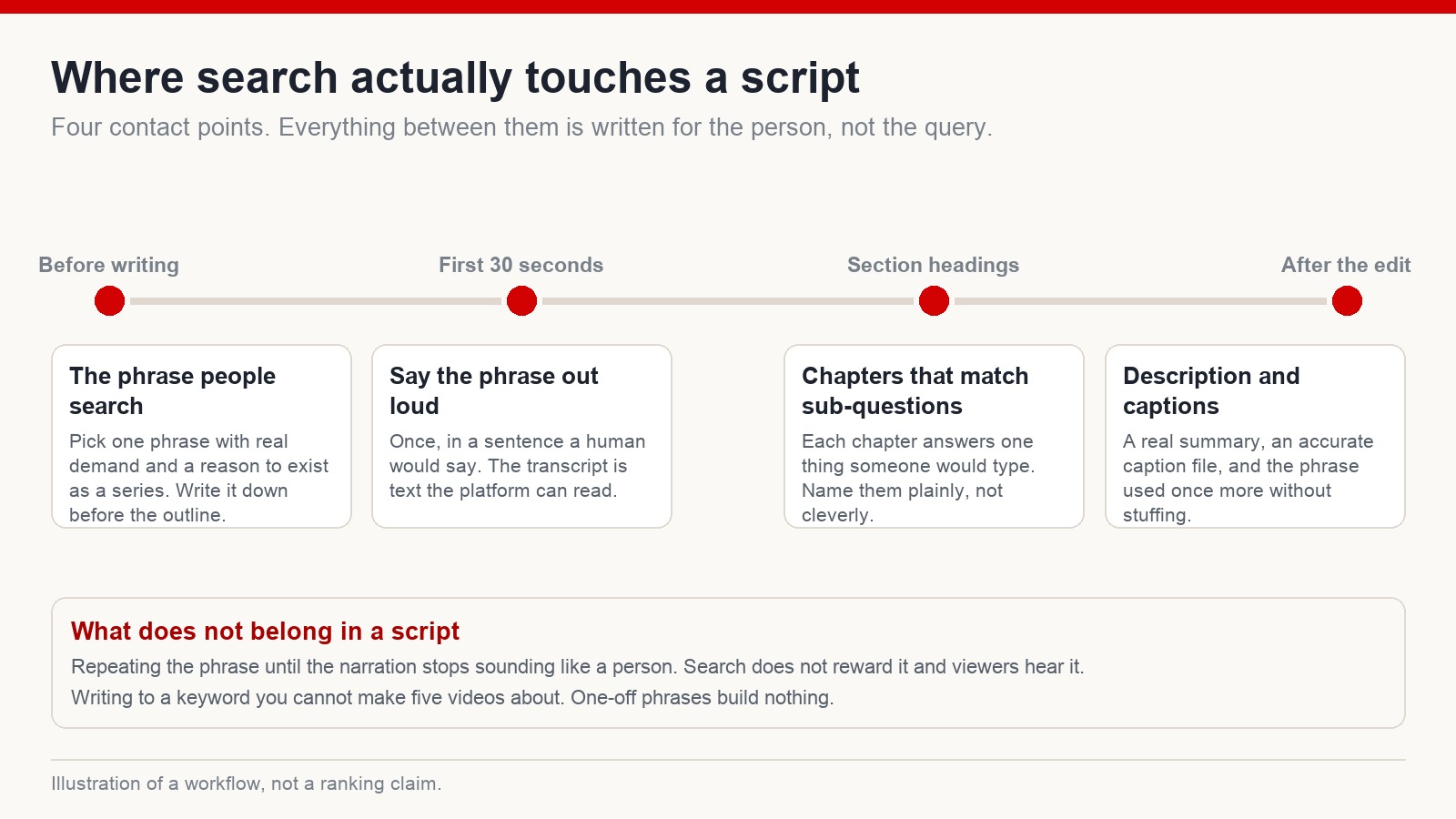
Four contact points. Everything between them is written for the person watching.
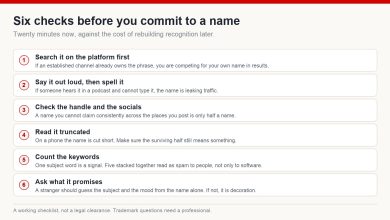
Say the phrase once, early, in a sentence a human would say. Not because a keyword in the first ten seconds is a ranking lever — the platform reads your transcript and your metadata anyway — but because it confirms to the viewer, immediately, that they are in the right place. Somebody who searched “why does my microphone sound bad” wants to hear that they have landed on that exact thing.
Write chapters that match sub-questions. If the outline sections are named after the questions a searcher would type, two useful things happen: the video becomes navigable, and the structure stops drifting away from what people came for. Name them plainly. Clever section titles help nobody.
Do the description and captions properly after the edit. A real summary, an accurate caption file, and the phrase used once more in a sentence. Not a keyword list. Automatic captions are usually decent and usually wrong in exactly the places that matter — proper nouns and technical terms — so it is worth correcting the file rather than leaving it.
Intent decides the shape of the script
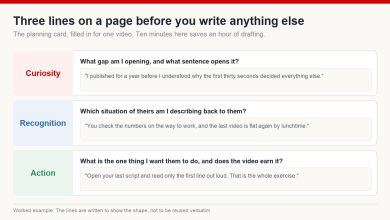
The most useful thing search research gives you is not the phrase. It is what the phrasing tells you about what the person wants, which in turn tells you how to build the video.
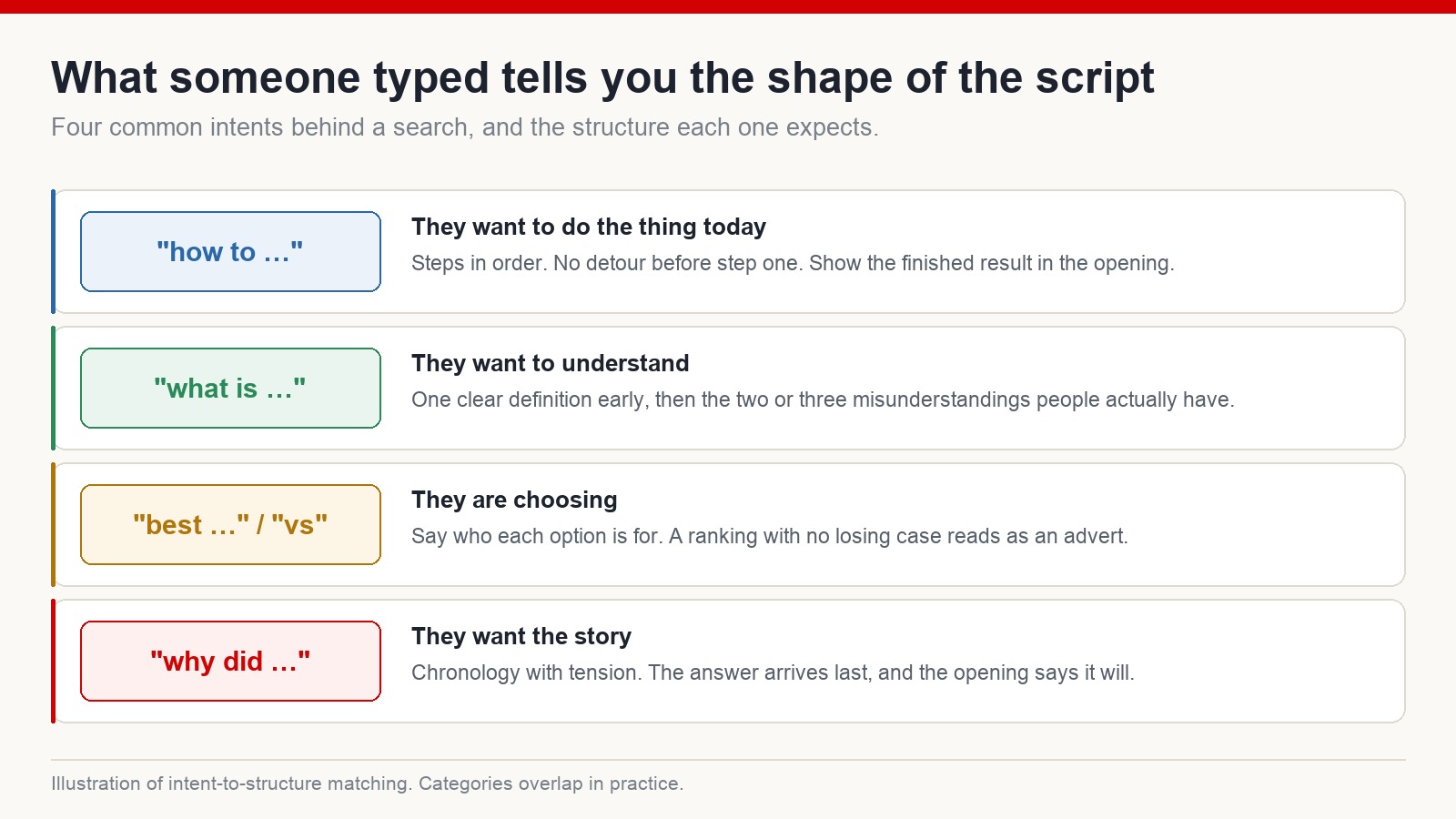
Get this wrong and the video is judged as a failure even when it is good. A viewer who typed “how to” and gets eight minutes of history before step one leaves, and they are right to. A viewer who wanted the story and gets a numbered checklist leaves too.
Writing for American ears
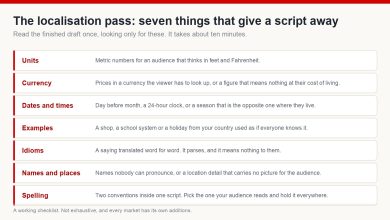
Once the structure is right, the remaining friction is in the language itself. A few things carry most of it:
- Units and formats. An American audience thinks in miles, Fahrenheit and pounds, and reads dates month-first. Converting is not pandering; it is the difference between a viewer picturing something and a viewer doing arithmetic.
- Spelling and vocabulary. Pick one variety of English and hold it across the script, the titles and the captions. Mixing them reads as careless.
- Reference points. Comparisons only work if the audience knows both halves. A distance compared to a landmark nobody in the audience has heard of is a dead sentence.
- Idiom. Idioms translated word-for-word from another language are the fastest way to sound off. If you are not certain a phrase is used naturally, write the plain version instead — plain never sounds foreign.
- The narration itself. Read the whole script out loud before recording, or have somebody who speaks the language natively read it. Every awkward line reveals itself in the mouth long before it does on the page. A model can help clean up a draft, but it will confidently produce phrasings nobody says.
The opening still has to be honest
Search brings people to the door. It does not keep them, and a title that promises more than the video delivers costs more than it earns — an audience that feels misled does not return, and the next video starts from a worse position.
So the hook has to be genuinely interesting and an accurate description of what is coming. Both. If you cannot write an opening that is both, the problem is usually the video rather than the opening.
Land the picture on the word
One production rule matters more than the rest for this kind of video: when the narration names something, that thing should be on screen at the moment it is named — not five seconds later while the voice has moved on. Sound and picture describing the same thing at the same time is what makes a video feel effortless to follow, and it costs nothing but attention in the edit.
Asking for a response
A simple invitation at the end is fine: what would you like covered next, what did I get wrong, what happened when you tried it. What is not fine is engagement bait — numbered comments, “type 1 if you agree” — which breaks the platform’s spam policy.
And a caveat worth stating: there is no evidence that any particular call-to-action wording makes a video more likely to be recommended. Ask because you want the answers.
Frequently asked questions
Does search-optimised scripting increase RPM? Not directly. What advertisers pay depends on the audience’s country, the subject, the format and the ad types — not on how the script was researched. Serving a market where advertising is expensive can change RPM; writing to a keyword does not.
Is there a search volume number I should aim for? No universal one. The useful judgement is relative: enough demand that the video is worth making, little enough competition that yours can be found, and enough neighbouring questions to build a series. Tool volumes are estimates and differ between tools.
Do I have to say the keyword out loud? It is not required. It is a good habit for a different reason — it confirms to the viewer within seconds that they are in the right place.
Can AI write the whole script for a market I do not live in? It can draft. It cannot tell you whether a phrase sounds natural to somebody who grew up hearing it, and it will produce confident errors. Read the script aloud, and get a native speaker’s eye on anything you are unsure about.
Where to start
Take the next video you plan to make and do three things before writing a word: write down the exact phrase somebody would type, decide which of the four intents it belongs to, and list the five neighbouring questions that could become the next five videos. If you cannot fill in the third one, the topic is a one-off and probably not where a channel should start.
If you want the full research, scripting and production process for faceless channels aimed at international audiences, it is at mmoyoutube.com. Platform behaviour changes and results vary between channels and niches.